
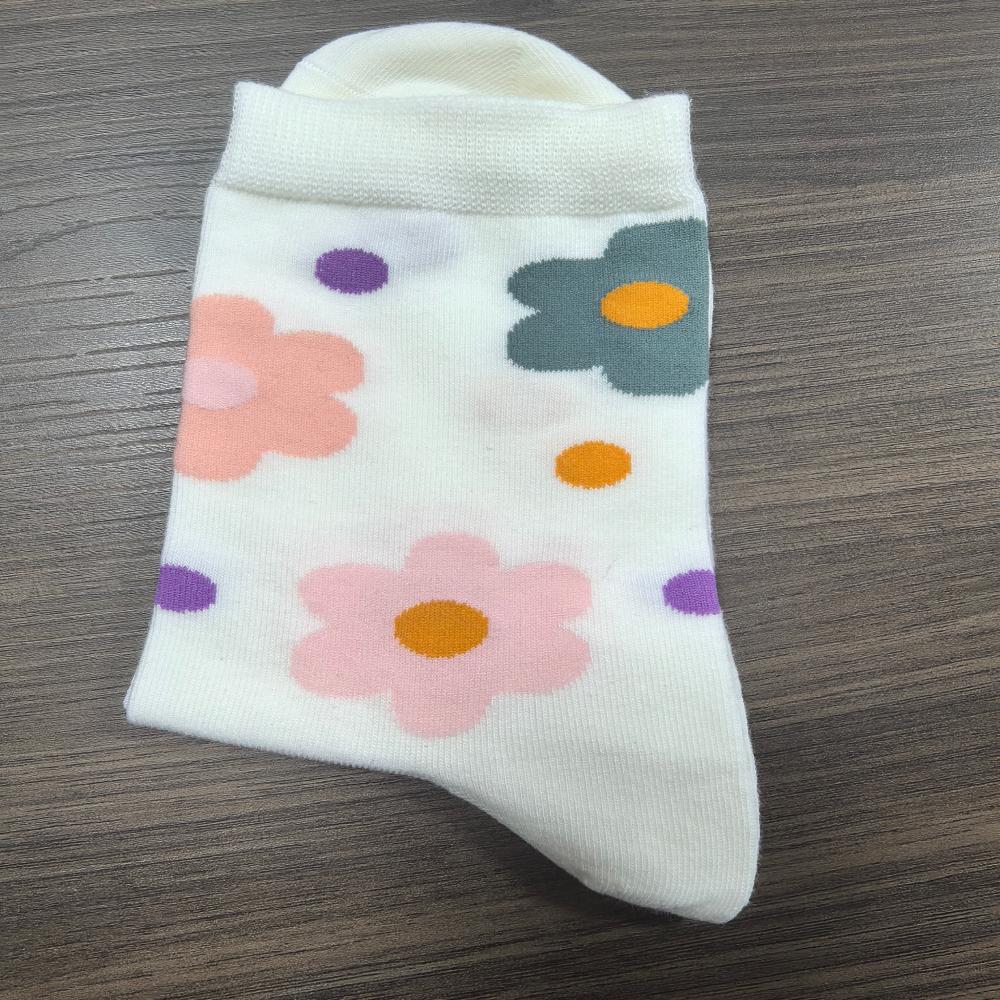
When a sock listing gives two size numbers without named axes, ask the supplier to identify the measured object, directions and presentation condition before using those values. Yuyi Socks’ mid-calf reference lists a size of 23 × 20 cm. Keep that as a catalogue entry awaiting explanation, rather than assigning the numbers to a foot-size range or particular sock dimensions. A marked supplier reference should show which points each value connects and how the garment was presented when measured.
Start with the catalogue entry as written
Send the exact mid-calf sock product link and quote the size entry in its original order. Ask the supplier what the entry describes for the offered version. The official reference shows a cream-coloured floral sock, which helps identify the enquiry, but a photograph without a scale cannot independently explain a pair of catalogue numbers.
Keep the two values together until their meanings are confirmed. Do not decide that the first number must describe the foot and the second must describe the leg, or reverse the numbers to suit an existing buying form. The supplier should identify the reference behind each value rather than leaving the buyer to choose a familiar interpretation.
Name the physical object being measured
Ask whether the entry describes the sock itself, another product reference or a supplier-defined size convention. If it describes the sock, ask which part belongs to each value. A generic size heading does not establish whether a value is an overall span, a section length or another measurement taken from the garment.
The answer should identify a physical measurement object that a colleague can recognise. For example, a supplier may return its own marked reference with named endpoints. Accept the supplier’s actual explanation rather than replacing it with a buyer-created dimensional method that has not been agreed for this product. Keep any unclear part of the answer open for clarification.
Catalogue detail | Question to clarify | Record with the confirmed entry
Two-number size | What physical reference does each value describe? | Named object and value assignment
Direction sequence | Which direction is represented first and second? | Explicit axis labels
Endpoints | Where does each measurement start and finish? | Marked supplier reference
Garment presentation | How is the sock positioned when measured? | Stated presentation condition
Size convention | Is this a garment dimension or another sizing reference? | Supplier’s defined meaning without inferred fit
Ask for marked axes and endpoints
Request an annotated reference showing the start and finish of each measurement. Where the cuff is folded in a photograph, ask the supplier which edge its method uses and how the cuff is presented. A visible fold is an identification feature, not permission to add or subtract a guessed length from the catalogue entry.
Keep the measuring direction explicit if an edge or section is curved. Ask the supplier to identify whether its value follows a named path or represents a straight span. Do not substitute one method for the other. The enquiry should obtain a repeatable reference for the offered version, without inventing a measurement standard or acceptance tolerance.
Keep presentation condition beside the dimensions
Ask the supplier how the sock is presented when its measurements are reported. A condition described for one value should not silently be applied to a different method or garment version. Record the supplier’s explanation with the marked reference so the buyer knows which dimensional question has actually been answered.
Do not calculate an extended size, stretch allowance or wearing range from the catalogue numbers. The page’s material description does not provide a quantified stretch or recovery result. Any separate requirement for sizing, fit or dimensional assessment needs its own supplier response and an agreed basis appropriate to the actual order.
• Copy the catalogue entry without assigning unconfirmed axes.
• Name the measured object before comparing values.
• Request marked endpoints and the supplier’s measurement method.
• Keep garment dimensions separate from wearing-size claims.
Compare returned measurements on the same basis
When comparing quotations or versions, check that the entries describe the same object and method. Two products can display similar numbers while using different reference points. Ask for the missing explanation rather than ranking the offers as equivalent solely because the numerical entries appear to match.
If the supplier changes its reference or clarifies an earlier label, retain that explanation with the quotation. Do not transfer it to another sock style without confirmation. A resolved axis question defines the meaning of the reported dimensions; it does not independently confirm fibre percentages, comfort, fit, durability or the result of a sizing test.
Send a measurement-axis clarification request
An enquiry can read: For the linked mid-calf sock, please explain the size entry of 23 × 20 cm. Identify the measured object and the value belonging to each direction. Mark the start and finish points and state the garment presentation condition. Please distinguish these measurements from any separately offered wearing-size reference.
Keep the accepted response with the product link and quotation identity. If the product or measuring method changes, request a replacement marked reference for the affected version. This creates a clear dimensional record without estimating scale from the photograph or turning an unlabeled catalogue entry into an unsupported foot-size or fit promise.
Frequently asked questions
Does 23 × 20 cm establish a foot-size range?
Ask the supplier what the entry measures. Do not treat an unlabeled dimensional pair as a confirmed wearing-size range.
Can the photograph identify the two measurement directions?
Request a marked supplier reference with named endpoints and axes rather than assigning directions from the image.
Should a folded cuff be added to the reported length?
Ask which cuff presentation and edge the supplier’s measurement method uses; do not adjust the value by estimation.
Does a clarified dimension guarantee fit or stretch performance?
Keep any required fit assessment or stretch information separate from the measurement-axis clarification.
Product and contact references
Product reference: https://yuyisocks.com/product/mid-calf-socks/
Related sock styles: https://yuyisocks.com/products/
Contact Yuyi Socks: https://yuyisocks.com/contact/
Yuyi Socks blog: https://yuyisocks.com/blog/