
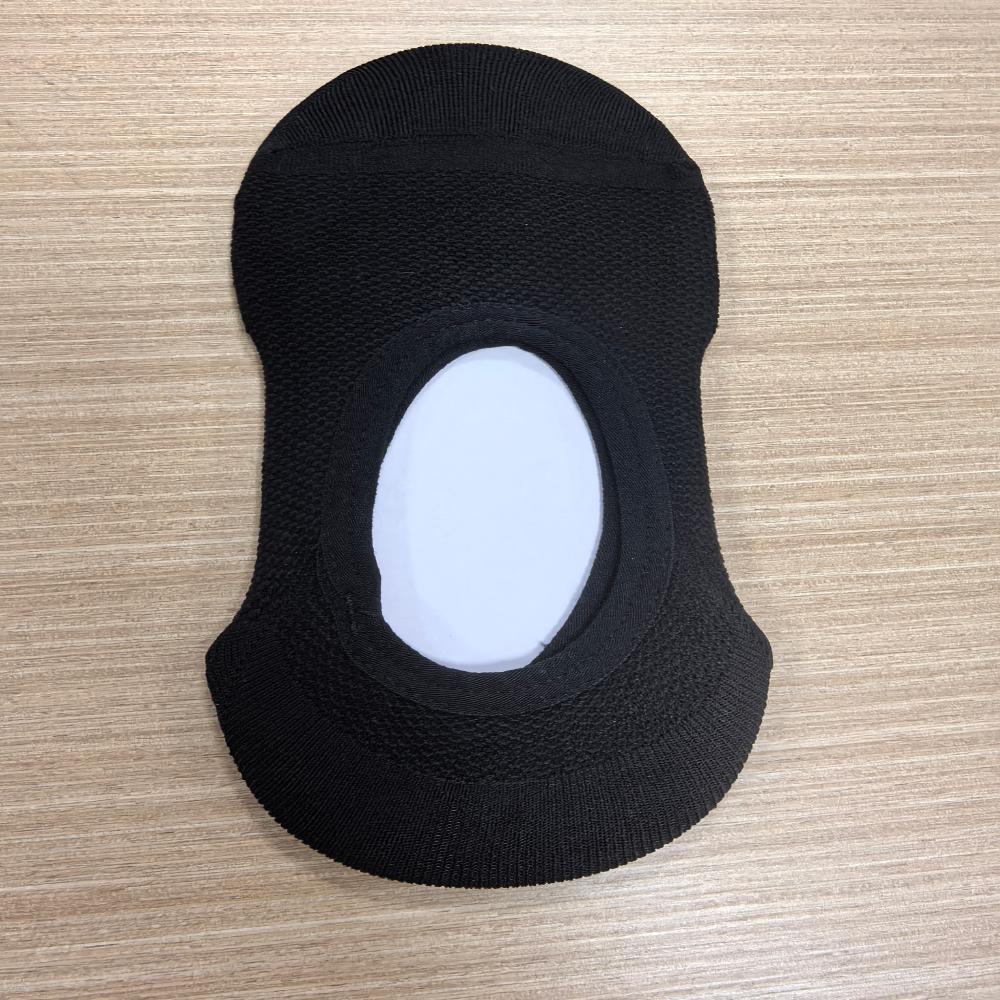
For a no-show sock RFQ, ask Yuyi Socks to identify the front and heel directions and mark the actual garment edge around the opening. Keep that outline attached to the offered version instead of judging the shape from a styled display alone. The official reference identifies a low-cut sock, but it does not prove that the opening will remain hidden in a particular shoe or establish an anti-slip result. Approve the referenced shape separately from any requested wearing or performance assessment.
Identify the offered opening before judging its appearance
Attach the exact nylon-invisible-sock product link and identify the official image used for the enquiry. Ask the supplier which offered version corresponds to that reference. The source lists white and black colours, so keep the selected colour reference with the proposed opening shape instead of assuming that every alternative has an identical pattern.
State that the enquiry concerns the garment opening. This focuses the response on the physical boundary the buyer wants to review. An overall product photograph can be useful for identification while leaving the opening’s orientation unclear. Ask for the relevant view rather than assigning a front, heel or side from an unconfirmed display arrangement.
Request a front-and-heel orientation mark
Ask the supplier to label the front and heel directions on the opening reference. Keep the two side edges identifiable as well. This gives the buyer a shared orientation for comments such as a change near the front curve, without relying on the way the image happens to be rotated on a page.
If the supplier uses another naming convention, request an explanation and connect it to the marked reference. Do not assume that a visually wider end establishes the garment’s direction. The returned orientation should make it possible to point to the same part of the opening when the quotation, sample discussion or proposed revision is reviewed later.
Outline reference | Supplier clarification | Keep with the approved version
Front direction | Which end of the opening faces the front? | Clear mark on the garment reference
Heel direction | Which edge belongs to the heel area? | Separate heel label
Side edges | Which side boundaries define the proposed opening? | Identified left and right sides of the view
Display presentation | Which visible boundary is the actual sock edge? | Garment outline separate from any display support
Offered version | Which colour and product option use this outline? | Supplier reference linked to the quotation
Separate the garment edge from display support
Ask the supplier to mark the actual fabric boundary around the opening. If a display support, insert or background is visible through or beside it, keep that object outside the garment-outline approval. A contrast between two colours in a photograph does not automatically identify a separate supplied component or a particular edge construction.
Request a view that shows the relevant curve clearly when part of the edge is concealed or difficult to distinguish. Do not trace across a hidden section and call the result the supplier’s pattern. Any buyer annotation should remain a question or proposed change until the supplier confirms that it represents the offered garment accurately.
Describe shape changes against the marked reference
If the buyer requests another opening shape, identify the affected part on the oriented reference. Ask the supplier to confirm whether the proposed change can be offered and to return a corresponding version reference. Keep the request conditional instead of treating a drawn alternative as an available product.
Where dimensions are needed to explain the change, agree the relevant points and supplier method separately. The outline approval itself should identify which curve is under discussion. Do not invent a cut depth or alter a size entry simply to make an image look closer to the buyer’s preferred footwear silhouette.
• Identify front, heel and side directions on one reference.
• Mark the actual garment edge around the opening.
• Keep display supports outside the approved garment outline.
• Attach proposed shape changes to a supplier-confirmed version.
Keep outline approval separate from coverage and grip
A no-show product name does not establish how much sock will be visible with every shoe. If a buyer needs a particular footwear presentation, identify the relevant context and request a separate supplier response or an agreed assessment. Do not turn the catalogue photograph into a universal promise about hidden coverage.
The same distinction applies to the source’s breathable and anti-slip wording. An outline reference does not verify those performance descriptions. Keep any required material composition, grip or wearing information separate from the shape decision, and avoid attributing a tested result to a product merely because the opening resembles another sock already known to the buyer.
Send an opening-outline clarification request
An enquiry can read: Please provide an oriented opening reference for the linked no-show sock. Mark the front, heel and both side directions, and identify the actual garment edge separately from any display support. State which offered colour and version the outline represents. Please confirm any proposed shape alternative separately rather than treating our annotation as an accepted pattern.
Retain the supplier’s accepted reference with the quotation. Request a revised outline if the opening pattern or offered version changes. This creates a clear shape-approval record without assuming that an image proves shoe coverage, prescribing an unconfirmed cut or promising grip, comfort, fit or another unverified wearing result.
Frequently asked questions
Can the wider end in a photo be assumed to be the front?
Ask the supplier to mark front and heel directions on the actual garment reference.
Does a contrasting area inside the opening belong to the supplied sock?
Request identification of the garment edge and keep any display support outside the outline approval.
Does an approved opening shape guarantee hidden coverage in shoes?
No. Keep any particular footwear requirement or wearing assessment separate from the shape reference.
Does the outline establish anti-slip performance?
Request any required performance information separately; the opening shape and catalogue wording are not a tested grip result.
Product and contact references
Product reference: https://yuyisocks.com/product/nylon-invisible-socks/
Related sock styles: https://yuyisocks.com/products/
Contact Yuyi Socks: https://yuyisocks.com/contact/
Yuyi Socks blog: https://yuyisocks.com/blog/