
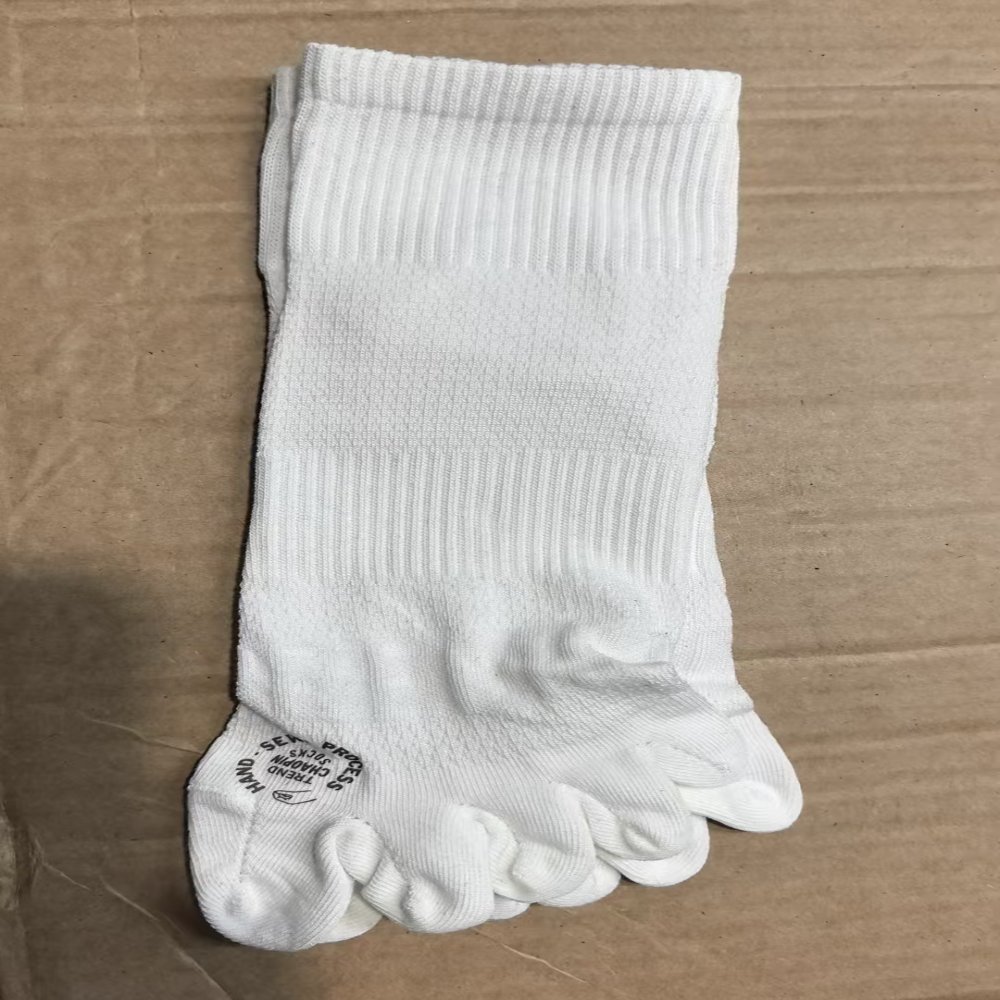
For a five-toe sock order, ask Yuyi Socks to identify the left and right garments and explain how they form the quoted pair. Keep that identification attached to the actual offered version rather than assigning a foot from the rotation of a catalogue image. The source describes individual toe separation and a ribbed cuff, but it does not define a pairing label or packing convention. Confirm the garment references, commercial unit and any requested identification separately before accepting the pair description.
Identify the offered five-toe reference
Send the exact toe-sock product link and identify the official white-sock reference. Ask the supplier which version is being quoted. The individual toe pockets make this a specific product enquiry, while the visible cuff and print help locate the reference without establishing its size, fibre percentage or performance.
State that the immediate question concerns garment pairing. Do not let a general product name substitute for an explanation of the two garments the buyer expects in the commercial unit. The supplier should identify the offered items clearly enough for the buyer to understand their relationship without reconstructing it from one photographed sock.
Ask the supplier to identify left and right
Request marked references for the left and right garments, using the supplier’s actual product identification. Ask which physical view and direction each mark represents. A photograph can be rotated or show a particular surface, so its position on the page should not determine the foot designation in the buying record.
If the supplier uses another pairing convention, ask it to explain that convention for the offered version. Do not invent an L or R marking, assume one is sewn into the cuff, or describe a visible decorative print as a foot-identification label. Keep supplier-confirmed identification separate from any new marking the buyer would like to request.
Pairing reference | Question for the supplier | Record with the order proposal
Left garment | Which actual garment and view identify the left reference? | Supplier-marked product reference
Right garment | Which actual garment and view identify the right reference? | Separate corresponding reference
Quoted pair | Which identified garments make up the commercial pair? | Explicit pair composition
Existing identification | How are the garments identified in the actual offer? | Confirmed marking or stated absence
Requested extra marking | Can an additional identification method be proposed? | Separate supplier confirmation and version reference
Define the quotation unit independently of the photograph
Ask the supplier to state whether the commercial line is expressed per individual sock, per defined pair or by another explicitly named unit. Keep that unit beside the left/right description. The number of garments visible in a catalogue photograph does not determine the unit used in a quotation.
Where the buyer’s order quantity uses pairs, request the supplier’s confirmation of the garments represented by each pair in the actual offer. Do not convert between units until the offered composition is clear. This avoids treating an individual-garment quantity as a paired quantity or assuming that a display view describes a complete retail pack.
Keep matching options attached to the pair
Ask which size and colour references apply to the two identified garments in the proposed pair. If the buyer wants matching options, state that requirement explicitly and request the supplier’s response. A general pair name should not conceal whether the returned proposal uses the same option reference for both garments.
If a supplier proposes an assortment or another pairing arrangement, request the actual composition of that proposal before accepting it. Do not assume that an assortment is available because the buyer requests one. Keep any option changes attached to a revised pairing statement so a later quotation does not silently inherit the original pair description.
• Request supplier-marked references for the offered left and right garments.
• Keep the commercial unit separate from the number shown in the image.
• Confirm which garment options belong together in the proposed pair.
• Treat any added identification or assortment as a separate request.
Separate pair identification from wearing claims
A defined left/right pair identifies the proposed supplied garments. It does not independently establish fit, comfort or a tested outcome during wear. If those matters are relevant to the order, request the applicable product information and any agreed assessment separately from the pairing approval.
The catalogue also uses language about friction, breathability and moisture management. Do not repeat those descriptions as verified results based on the toe-pocket structure or photograph. Keep the enquiry focused on the pairing decision unless the supplier provides separately relevant information for another purchasing requirement. No medical or protective result follows from a confirmed pair description.
Send a left-and-right pairing request
An enquiry can read: Please identify the left and right garments for the linked five-toe sock reference using marked product views. State which garments form the quoted pair and whether the commercial line is per individual garment or per pair. Confirm the size and colour references belonging together and explain any existing identification method separately from requested additional markings.
Retain the accepted response with the quotation and product version. Request an updated pairing statement if the offered garments or options change. This gives the buyer a clear order-unit decision without assigning a foot from image orientation, inventing a garment label, assuming a retail pack or promising an unverified fit or wearing benefit.
Frequently asked questions
Can one product photograph establish the offered pair?
Ask the supplier to identify the actual garments and state which items compose the quoted pair.
Does image rotation determine whether a sock is left or right?
Use supplier-marked product references rather than the position of the image on the page.
Can an L or R label be assumed to be present?
Request confirmation of existing identification, and treat any additional marking as a separate proposal.
Does a confirmed pair establish friction reduction or fit?
No. Keep any required wearing or performance information separate from the garment-pair identification.
Product and contact references
Product reference: https://yuyisocks.com/product/toe-socks/
Related sock styles: https://yuyisocks.com/products/
Contact Yuyi Socks: https://yuyisocks.com/contact/
Yuyi Socks blog: https://yuyisocks.com/blog/